ORBEX-A · Research review

Mission readiness

A common payload release, coordinated approach, attachment, detumbling and orbital lowering. Envisat is the default; target geometry, hardware and fleet size are explicit inputs.

The complete nonlinear mission remains unverified. The studio now opens the current sensed approach record. Unreached stages are not animated as completed.
  1. Deploy300 m cluster
  2. Approachcurrent record
  3. Attachnot reached
  4. Detumblenot reached
  5. Lower orbitnot reached
4 × 22matched development updates · 21.15 s per arm
4 of 4drag candidates remain · useful learning unproven
88 / 88updates miss the physical timing budget

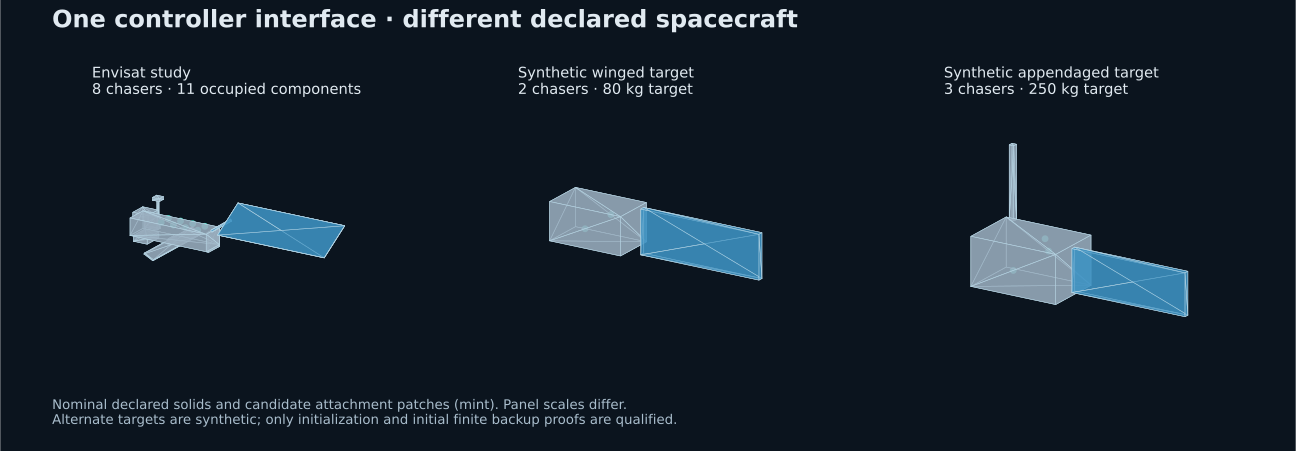
Different spacecraft. The same interfaces.

Declared Envisat and two synthetic spacecraft with different solar wings, appendages and attachment points.
Two alternate targets, with two and three chasers, install initial nonlinear finite backups using their own mass, inertia and propulsion. Their complete missions remain unverified. Download input examples ↓

What changed — and what remains

Independent feedback Near control checked

Backup renewal is checked. A declared 25 m case executes 128 planned holds at the shorter cadence. Physical timing still fails.

Linked identification Learning unproven

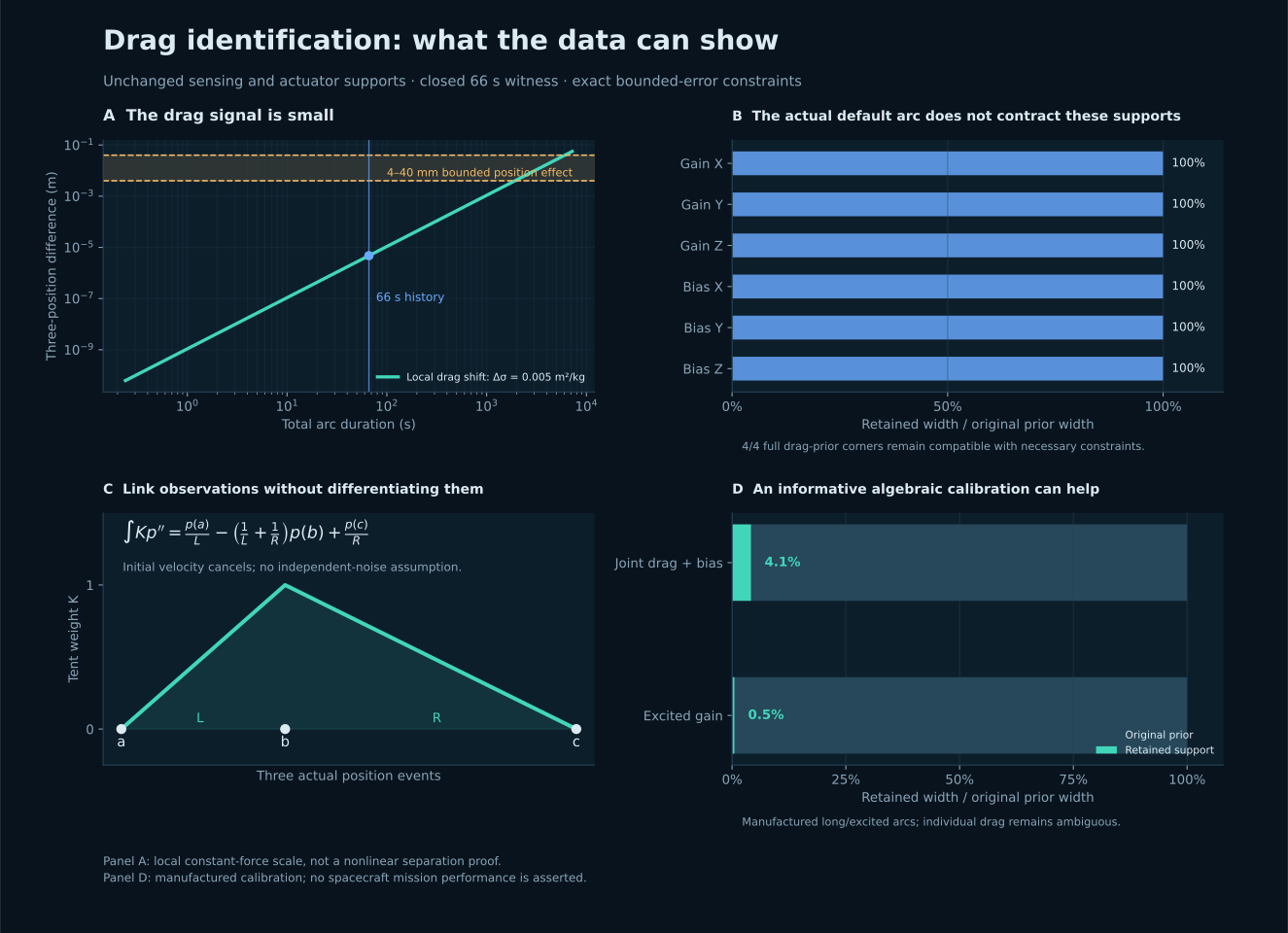
Shared actuator hypotheses persist over observations. A new integral estimator supports longer arcs; the closed 66 s history still gives no certified parameter contraction.

Contact and lock Record check open

The latest fixture reports all eight contact points reached. Its endpoint/swept-set consistency check remains open; attachment is unverified.

One complete mission Still open

The same admitted run must reach every attachment, detumble and lower the orbit with intact sensing, command and fuel records. Short successful components do not establish this.
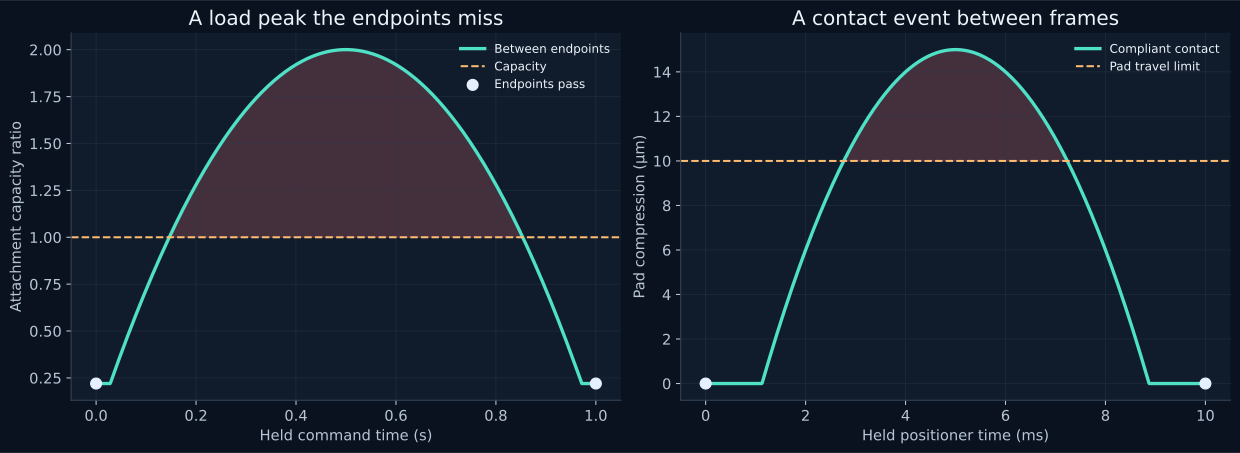
Catch what endpoints miss

Interior force overload and contact compression exceed limits despite acceptable endpoint samples.
Constructed counterexamples: endpoint checks accept, whole-step bounds refuse. These qualify the declared contact/load models, not a completed capture.

Renew the backup while feedback continues

Closed sensed execution crosses the original finite expiry using a newly proved continuation, with physical timing failures shown separately.
2,200 acknowledged fleet holds, actual delayed sensing and an independently rebuilt extension. Numerical continuity passes; physical timing still fails.
Why the approach stalled

Near control requires shorter holds. Each now receives a proportionally smaller numerical error allowance, preserving the original comparison bound.

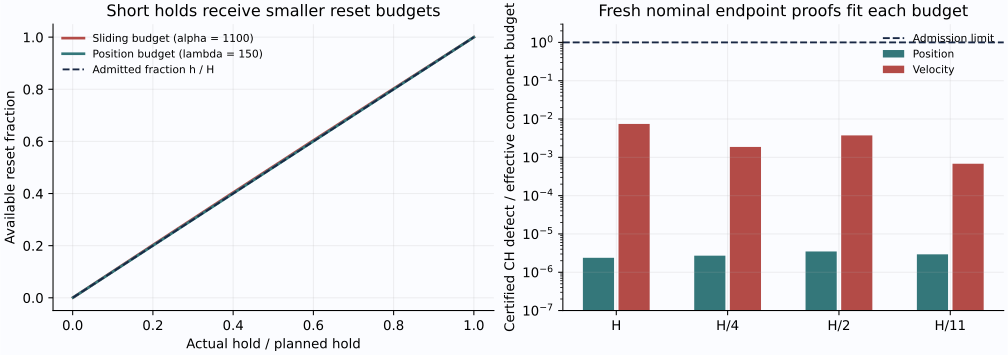
An independently audited declared 25 metre component executes 128 performance holds after 128 mandatory sensor-priming holds, with an admitted new finite backup.
A declared 25 m component, not the 300 m mission. All eight solves and 1,024 shortened nominal transfers pass; computation remains slower than physical time.
Shorter holds receive smaller certified numerical reset allowances, and actual nominal endpoint defects remain within those reduced allowances.
Numerical nominal-flow qualification, separate from nonlinear physical admission. Derivation and assumptions →
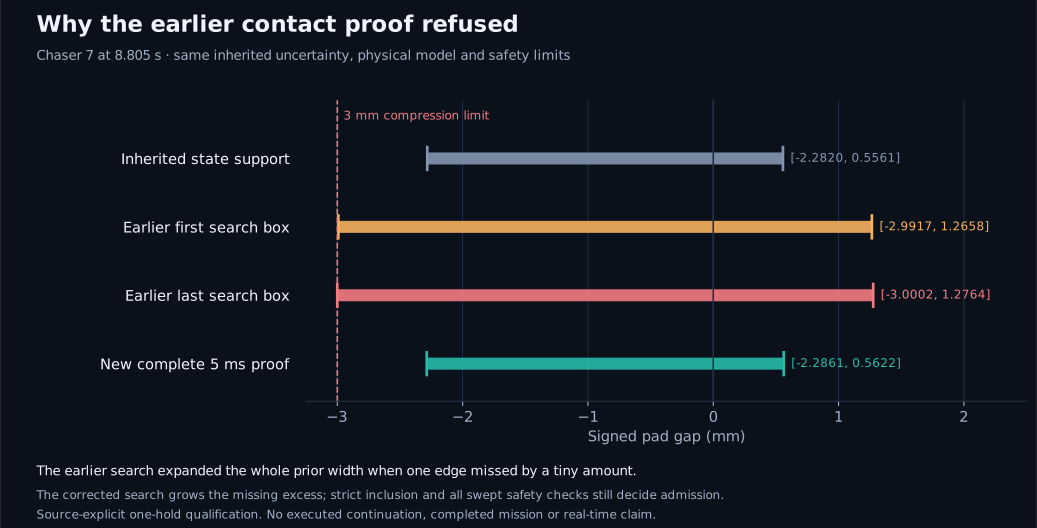
Why a contact proof can fail
At the same contact boundary, retaining wrench correlation reduces the complete five millisecond conservative moment bound from 5.117 to 4.997 newton metres, against the unchanged five newton metre limit.
One 5 ms boundary, unchanged sensing and capacity. The remaining margin is small; this does not complete attachment.
A failing Picard trial had amplified inherited position uncertainty. Growing only uncovered image excess proves the same held boundary under the unchanged three millimetre compression limit.
Same held boundary and 3 mm compression limit. The exact trial search retains all prior support; complete trace consistency is checked separately.
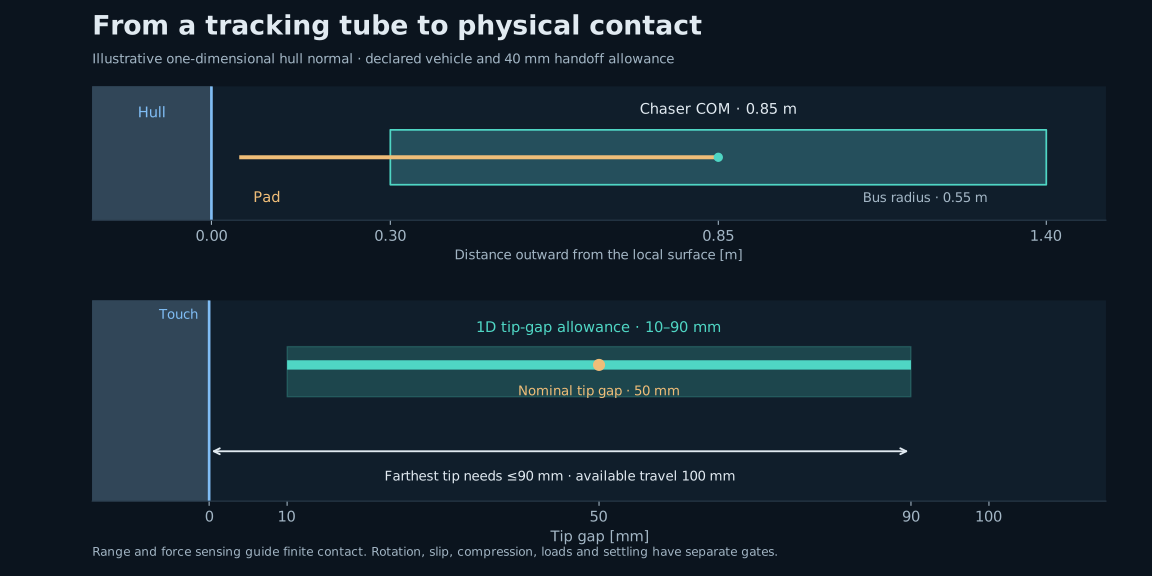
From the tube to physical contact
Illustrative one-dimensional standoff geometry: a 50 mm tip gap with a 40 mm position allowance and 100 mm finite mechanism reach.
Dimensional explanation, not an executed capture. Rotation, patch geometry, slip and loads have separate gates.
Measured terminal tube tradeoff: smaller sliding gain leaves more velocity margin at the cost of position radius.
A closed terminal optimization comparison under its declared near-sensing support. The complete gripper-speed gate still applies.
Tighter geometry without changing the spacecraft

For a projection direction \(n\), expanded component vertex \(v\) and proper rotation \(R\), orthogonality gives \(|n^T Rv|\le\|n\|_2\|v\|_2\). Exact squared radii and outward square roots retain the full uncertainty-expanded solid.
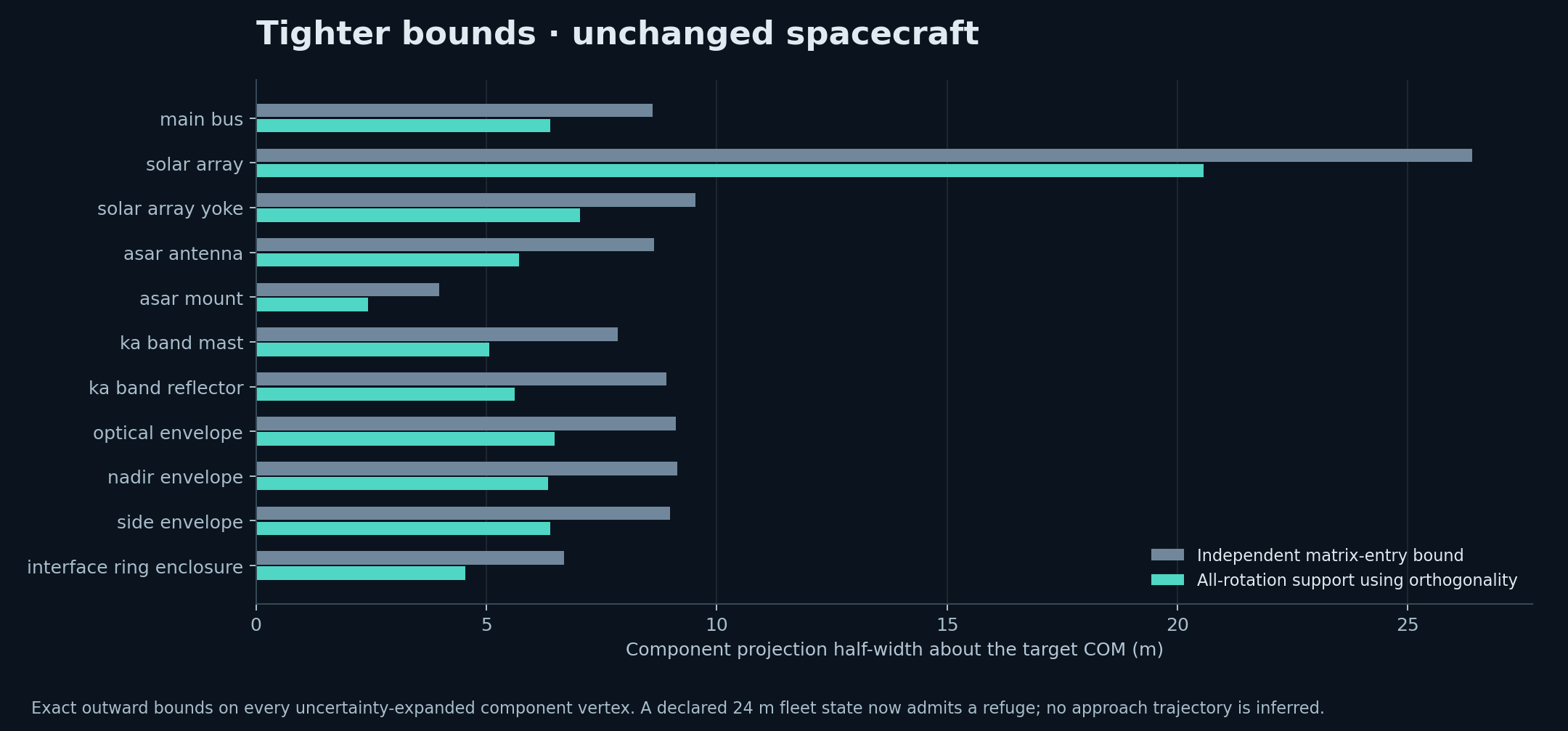
Before and after component projection bounds; every actual component and uncertainty remains.
A declared 24 m eight-chaser state admits a complete refuge previously refused by loose rotation-entry bounds. This is a proof-setup comparison, not a flown approach.
What the observations can identify
Actual 66-second history retains drag uncertainty; a separate manufactured calibration narrows only the joint force effect and an excited actuator gain.
The actual mission history gives no certified parameter contraction. The informative calibration is a separate constructed example.
Where the feedback time goes
Measured command-path timing exceeds the physical feedback period, including observed execution spikes.
This replay excludes numerical plant integration, synthetic packet generation and durable evidence storage. It still misses the physical period.
Configure another spacecraft

Geometry, mass, inertia, attachment points and hardware share one mission declaration. The near boundary now covers the whole target and arm offset. Existing Envisat backups stay identical; large-target and long-arm geometry fixtures check the new selection.

Mission configuration → · Target-radius setting →

Research behind these choices
Primary workDecision for ORBEX-A
Sasfi et al. · adaptive nonlinear tubes · 2023Keep nested truth-containing sets. Terminal and contraction hypotheses are required; smaller sets do not establish learning or arrival.
Buerger & Cannon · adaptive NMPC · 2026Retain feasible continuations. Replacing GEKKO needs valid nonlinear remainder and terminal ingredients, plus a measured benefit.
Frey et al. · AS-RTI · 2024Prepare expensive work early; measure the entire admitted-command cycle. A fast solve is not an online safety result.
Quartullo et al. · rotating-target rendezvous · 2026Progress into a finite capture set needs its own argument. Its linear known-target theorem does not certify uncertain nonlinear contact.
Botelho et al. · rendezvous feedback reuse · 2026Reuse complete policies under their conditions. A stored suffix also needs enough remaining fuel.
Jonsson et al. · multiple servicers · 2026 preprintA close guidance comparator. Exact inner-loop stability does not establish robust constrained capture or pad loads.
Exact evidence & qualification limits

The four 22-update runs include control after the first estimation update. Source, native solver outputs, complete archives, packet acquisition/delivery, geometry links and exact fuel/effort ledgers are independently authenticated. Interval differential proofs are not rerun by this archive audit.

All cases informed development. The common physical-time/channel noise field does not guarantee identical measurements or schedules. No held-out superiority or real-time guarantee follows.

Evidence JSON ↓ · Detailed readiness · Primary-source review